
Table of Contents
Choosing a canvas print is a deliberate choice — a way of shaping the feeling of a room, of bringing something meaningful into your everyday space. At AiMEiRi, every design is created with that intention in mind, drawing on the principles of East Asian philosophy and art to produce pieces that encourage calm, balance, and presence.
But even the most carefully crafted print needs a little attention to stay looking its best. Canvas responds to its environment. Light, humidity, dust, and temperature all affect it over time. The good news is that caring for your canvas print is simple once you know what to do.
Whether you’ve purchased a framed or floating-framed print from AiMEiRi — or are simply looking for guidance on prints you already own — this guide covers everything you need to keep your artwork looking beautiful for years to come.
What Are Canvas Prints Made Of? (And Why It Matters for Care)
Before getting into the tips, it helps to understand what you’re working with.
Canvas prints are made up of a few key components. The canvas itself is the foundation — the surface that holds the ink and gives the print its texture and body. The image is printed directly onto this surface using water-based or solvent-based inks, which bond with the canvas fibers to produce vivid, lasting color. All AiMEiRi canvas prints come framed, with wooden stretcher bars that hold the canvas taut and give the piece its structure. I also offer a floating frame option, which suspends the canvas inside a slightly larger outer frame, creating a gap between the canvas edge and the frame — a contemporary look that lets the full printed surface remain visible.
I produce my prints on a polyester-cotton blend canvas — a deliberate material choice that has meaningful advantages for print quality, longevity, and ease of care, which I’ll cover in the next section.
Why AiMEiRi Uses a Polyester-Cotton Blend Canvas
Not all canvas is the same, and the type of canvas your print is made on affects how it looks, how it ages, and how easy it is to maintain. Here’s a closer look at why a polyester-cotton blend is a strong choice for canvas prints — and where its limitations lie.
The Advantages
Better ink adhesion and color vibrancy. Polyester fibers have a smoother, more uniform surface than pure cotton, which allows ink to sit more consistently across the canvas. The result is sharper detail, brighter colors, and more consistent tonal gradients — all of which matter for digitally designed artwork like mine.
Greater resistance to moisture. Polyester is a synthetic fiber that does not absorb water the way natural fibers do. In a blend, this significantly reduces the canvas’s tendency to absorb ambient humidity, which in turn reduces the risk of warping, sagging, or mildew development. This makes poly-cotton blend canvas more forgiving in environments where humidity fluctuates.
Improved dimensional stability. Pure cotton canvas is more prone to expanding and contracting with changes in temperature and humidity — a property that, over time, can cause warping or the canvas to pull unevenly on its stretcher bars. The polyester component in a blend resists these changes, helping the canvas maintain its shape and tension more consistently over the long term.
Durability and resistance to wear. Polyester fibers are inherently strong and resistant to stretching, tearing, and abrasion. A poly-cotton blend canvas is generally more durable in everyday conditions than a pure cotton alternative, making it a practical choice for art intended to be a lasting part of a home.
Easier to clean. Because polyester doesn’t absorb moisture readily, spills and smudges tend to sit on the surface rather than immediately soaking in, giving you a slightly longer window to address them before they set. The blend’s durability also means the surface can withstand careful cleaning without degrading as quickly as a more delicate pure cotton surface might.
The Drawbacks
In the interest of giving you a complete picture, it’s worth being transparent about the limitations of polyester-cotton blend canvas as well.
Less of a traditional aesthetic. Pure cotton canvas has a texture and warmth that many art collectors associate with traditional, fine art canvas. A poly-cotton blend, while visually similar, has a slightly smoother and more uniform texture that some purists find less characterful. For digitally created artwork this distinction is minimal, but it’s worth knowing if you’re comparing materials.
Potential for static buildup. Polyester is prone to generating static electricity, which can attract dust more readily than a natural fiber canvas. This makes regular dusting — covered in Tip 2 — particularly important for poly-cotton blend prints.
Less breathable than pure cotton. Natural cotton canvas allows for more airflow through the material. While the polyester component improves moisture resistance, it also reduces breathability, which means that if moisture does get trapped behind the canvas — between the print and the wall, for example — it may linger longer than it would with a pure cotton canvas.
Environmental considerations. Polyester is a synthetic, petroleum-derived fiber and is not biodegradable in the way natural cotton is. For environmentally conscious buyers, this is a fair consideration. That said, a longer-lasting canvas — one that doesn’t warp, sag, or degrade prematurely — means less waste over time.
Understanding these trade-offs gives you a more complete picture of what your print is made of and why. Overall, for digitally printed home décor art, a polyester-cotton blend offers a strong balance of quality, durability, and ease of care — which is why it’s the material I use for all AiMEiRi prints.
Standard Framed vs. Floating Framed Canvas Prints: Key Care Differences
All AiMEiRi prints come framed, but I offer two framing options — a standard frame and a floating frame — and each has slightly different care considerations worth knowing upfront.
With a standard framed print, the canvas wraps around the stretcher bars and the frame sits flush against the canvas edges. This creates a clean, traditional look and provides solid structure. The main care consideration is the gap between the back of the canvas and the wall, which can trap dust and, in humid environments, moisture.
With a floating framed print, the canvas sits inside a slightly larger outer frame with a visible gap between the canvas edge and the frame border. This contemporary style keeps the full printed surface visible and creates a sense of depth. Because of the open gap between the canvas and the frame, floating frames have a bit more exposure on the canvas edges — these edges can collect dust more readily and should be included in your regular dusting routine. The gap also means slightly more airflow around the canvas, which can be a minor advantage in terms of moisture management.
Both framing styles share the same core care principles, and the tips below apply equally to both. Specific callouts are included where the advice differs.
Tip 1: Hang and Place Them in the Right Spot
Where you hang your canvas print has more impact on its longevity than almost anything else. Get the placement right from the start, and you eliminate many of the most common causes of fading, warping, and deterioration.
The most important rule is to avoid direct sunlight. UV radiation is one of the leading causes of canvas print damage — it breaks down the pigment molecules in the ink over time, causing colors to fade, shift, or dull. This happens gradually, so it can be easy to miss until the damage is significant. Even a print that receives a few hours of direct sun each day will show noticeable fading within a few years. If your room gets a lot of natural light, consider UV-filtering window film or curtains, and position your prints away from the direct path of sunlight.
Humidity is the other major environmental threat. Although my poly-cotton blend canvas offers better moisture resistance than pure cotton, it is not immune to damage from sustained or extreme humidity. Bathrooms, kitchens, and laundry rooms experience frequent spikes in moisture that can still cause warping or mildew — particularly on the wooden stretcher bars and frame. These rooms are best avoided for canvas art display.
Beyond sun and humidity, keep your prints away from HVAC vents, fireplaces, radiators, and drafty windows. These create localized temperature fluctuations that stress both the canvas and the wooden frame components.
The ideal placement is a stable interior wall — one that doesn’t face outside, isn’t near a heat or cooling source, and receives indirect or artificial light. A living room, bedroom, hallway, or home office are all excellent choices.
Standard frame note: Before hanging, confirm your wall anchors and hardware are rated for the weight of the framed print.
Floating frame note: Because the canvas edges are exposed in a floating frame, extra care should be taken to avoid placing the print where it will receive direct airflow or moisture, as the exposed edges are slightly more vulnerable than those wrapped in a standard frame.
Tip 2: Dust Regularly and Gently
Dust is inevitable, but it doesn’t have to be a problem. A simple, consistent dusting routine keeps your canvas print looking fresh and prevents buildup that can cause longer-term issues.
The right tool for the job is a soft microfiber cloth or a soft-bristle brush — the kind used for delicate surfaces or camera lenses. Use light, straight strokes rather than circular motions. Circular scrubbing, even with a soft cloth, can grind dust particles into the woven texture of the canvas, making them harder to remove and potentially scratching the surface over time.
Because my poly-cotton blend canvas contains polyester, it may attract dust slightly more readily than a pure cotton canvas due to polyester’s tendency to generate static. Aim to dust your prints every one to two weeks to stay ahead of this.
What to avoid: feather dusters, which tend to redistribute dust rather than capture it; paper towels, which are more abrasive than they appear; and vacuum attachments without a dedicated soft brush head. If you use a vacuum, keep it on the lowest suction setting and hold the attachment slightly away from the surface rather than pressing it directly against the canvas.
Floating frame note: Don’t forget to dust the exposed canvas edges and the inner surfaces of the floating frame itself — the gap between the canvas and frame border is a spot where dust collects and is easy to overlook.
Tip 3: Clean Stains and Smudges the Right Way
Accidents happen. Whether it’s a fingerprint, a splash, or a smudge from moving the print, the key is to act quickly and calmly — and to use the right technique.
One advantage of my poly-cotton blend canvas is that the polyester content resists immediate moisture absorption, meaning spills and smudges are less likely to soak in instantly. This gives you a slightly better window to act before a stain sets — but don’t rely on this as a reason to delay.
Start with distilled water. Dampen a clean, soft cloth or cotton swab lightly — you want it barely moist, not wet — and blot the affected area gently. Blotting, rather than rubbing, lifts the substance away from the canvas without spreading it or pushing it deeper into the fibers. Never saturate the canvas with water, even given the blend’s improved moisture resistance. Excess moisture can still cause warping and can affect the ink over time.
If distilled water alone doesn’t do the job, add a single small drop of mild dish soap to a cup of distilled water, mix gently, and apply with a cotton swab using the same blotting motion. Rinse the area by blotting with a clean, water-dampened cloth afterward.
Why distilled water specifically? Tap water contains dissolved minerals that can leave faint residue on the canvas surface or interact with the ink over time. Distilled water is pure and leaves nothing behind.
What to avoid entirely: Windex and other glass cleaners, alcohol-based sprays, bleach, all-purpose household cleaners, and any product not specifically formulated for use on fabric or canvas. These can strip or react with the ink, leaving permanent damage that’s far worse than the original stain.
Floating frame note: When cleaning near the canvas edges on a floating-framed print, take extra care not to let moisture seep into the gap between the canvas and the frame border, where it could become trapped and cause damage to the stretcher bars or frame over time.
Tip 4: Protect Against Moisture and Temperature Fluctuations
Although my poly-cotton blend canvas is more dimensionally stable than pure cotton — meaning it is less prone to expanding and contracting with environmental changes — it is not entirely immune. Sustained or dramatic shifts in temperature and humidity can still affect the canvas and the wooden frame components.
The goal is stability. Aim to keep the room where your print is displayed at a consistent temperature between 60 and 75°F and a relative humidity between 45 and 55%. These are comfortable conditions for people as well as art, so in most well-maintained homes, this isn’t difficult to achieve.
If you live in a particularly damp climate, a dehumidifier in the room can make a meaningful difference. In very dry climates, a humidifier can prevent the canvas from becoming brittle. Avoid hanging prints directly on exterior-facing walls, which tend to be cooler and more prone to condensation, and never store prints in basements, attics, or garages where conditions are uncontrolled.
Standard frame note: Periodically check the back of your framed print for any signs of moisture accumulation or mildew. Because the polyester content reduces breathability slightly, any moisture that becomes trapped may linger longer than it would with a pure cotton canvas.
Floating frame note: The open gap in a floating frame allows slightly more airflow around the canvas, which can help with moisture management — but it also means the canvas edges are more directly exposed to the ambient environment. In humid conditions, keep a closer eye on the exposed edges for any early signs of warping or discoloration.
Tip 5: Store Your Canvas Prints Properly When Not in Use
Not every print is on display all the time. If you’re rotating your art seasonally, moving homes, or simply putting a piece away temporarily, proper storage is essential for keeping it in good condition.
For both standard and floating framed prints, store them upright rather than flat and stacked. Laying framed prints flat and stacking other items on top puts uneven pressure on the frame and canvas, which can cause warping or structural damage over time. Upright storage distributes the weight evenly through the frame.
Wrap your print in a soft blanket or furniture padding before storing — this protects the frame and canvas surface from scratches and impact. Avoid wrapping plastic directly against the canvas, as plastic can trap moisture. If the original packaging is available, that’s often the best storage option.
Store in a climate-controlled space — a temperature-stable interior closet is ideal. Never store canvas prints in basements, attics, or garages, where temperature and humidity can swing dramatically with the seasons.
Floating frame note: The exposed canvas edges on a floating-framed print are more vulnerable during storage and transport. Take extra care to protect the edges when wrapping, and consider adding a layer of acid-free tissue paper around the canvas edges specifically before wrapping in the outer blanket or padding.
Why acid-free materials? Acidic materials yellow and degrade over time and can transfer this degradation to whatever they’re in contact with. Acid-free tissue paper and storage materials are inexpensive, widely available, and make a meaningful difference in long-term preservation.
Common Mistakes to Avoid
- Using Windex or household glass cleaner. These products are formulated for glass, not canvas, and can strip or react with the ink permanently.
- Hanging prints in direct sunlight. UV damage is cumulative and irreversible. A little sun every day adds up quickly.
- Cleaning with paper towels or rough cloths. More abrasive than they look, these can scratch or distort the canvas surface texture.
- Neglecting the floating frame gap. The space between the canvas and frame border collects dust and is easy to forget during routine cleaning.
- Ignoring early signs of warping or moisture. These are early warning signs that are far easier to address before they compound.
- Storing prints in uncontrolled environments. Basements, attics, and garages are the enemy of canvas prints.
- Saturating the canvas during cleaning. Even with the improved moisture resistance of a poly-cotton blend, excess water is still damaging. Always use the minimum amount necessary.
- Storing framed prints flat and stacked. Always store upright to avoid uneven pressure on the frame and canvas.
FAQ: Canvas Print Care Questions Answered
Can I hang a canvas print in my bathroom? It’s not recommended. Bathrooms experience frequent and significant humidity spikes from showers and baths, which can cause warping or mildew over time — even on a poly-cotton blend canvas, which, while more moisture-resistant than pure cotton, is not waterproof. If you want art in your bathroom, consider a print behind glass, which provides a moisture barrier.
How do I remove a scuff or fingerprint from a canvas print? Start with a lightly dampened microfiber cloth and distilled water, blotting gently. For more stubborn marks, refer to Tip 3 above for the full cleaning process. The key is to act quickly and avoid rubbing.
Will my canvas print fade over time? All prints fade eventually, but the rate depends largely on environment. UV exposure is the primary driver — a print kept out of direct sunlight in a stable environment can retain its vibrancy for decades. My prints are produced with quality inks designed for longevity, but placement is the single biggest factor in how long that vibrancy lasts.
What’s the difference between a standard frame and a floating frame? A standard frame wraps the canvas edges and sits flush against them, creating a clean, traditional look. A floating frame suspends the canvas inside a slightly larger outer frame, leaving a visible gap between the canvas edge and the frame border. This creates a contemporary, gallery-style appearance and keeps the full printed surface visible. Both are available for all AiMEiRi prints.
How long do canvas prints last? With proper care, a quality canvas print on poly-cotton blend canvas can last several decades without significant deterioration. The blend’s improved durability and moisture resistance give it an advantage over pure cotton canvas in longevity, particularly in homes where humidity and temperature aren’t always perfectly controlled.
What’s the best way to ship or move a canvas print? Wrap the corners with foam corner protectors, then wrap the entire piece in bubble wrap or furniture padding. For floating-framed prints, add an extra layer of acid-free tissue paper around the exposed canvas edges before wrapping. Use a box with enough room for padding on all sides and mark the package clearly.
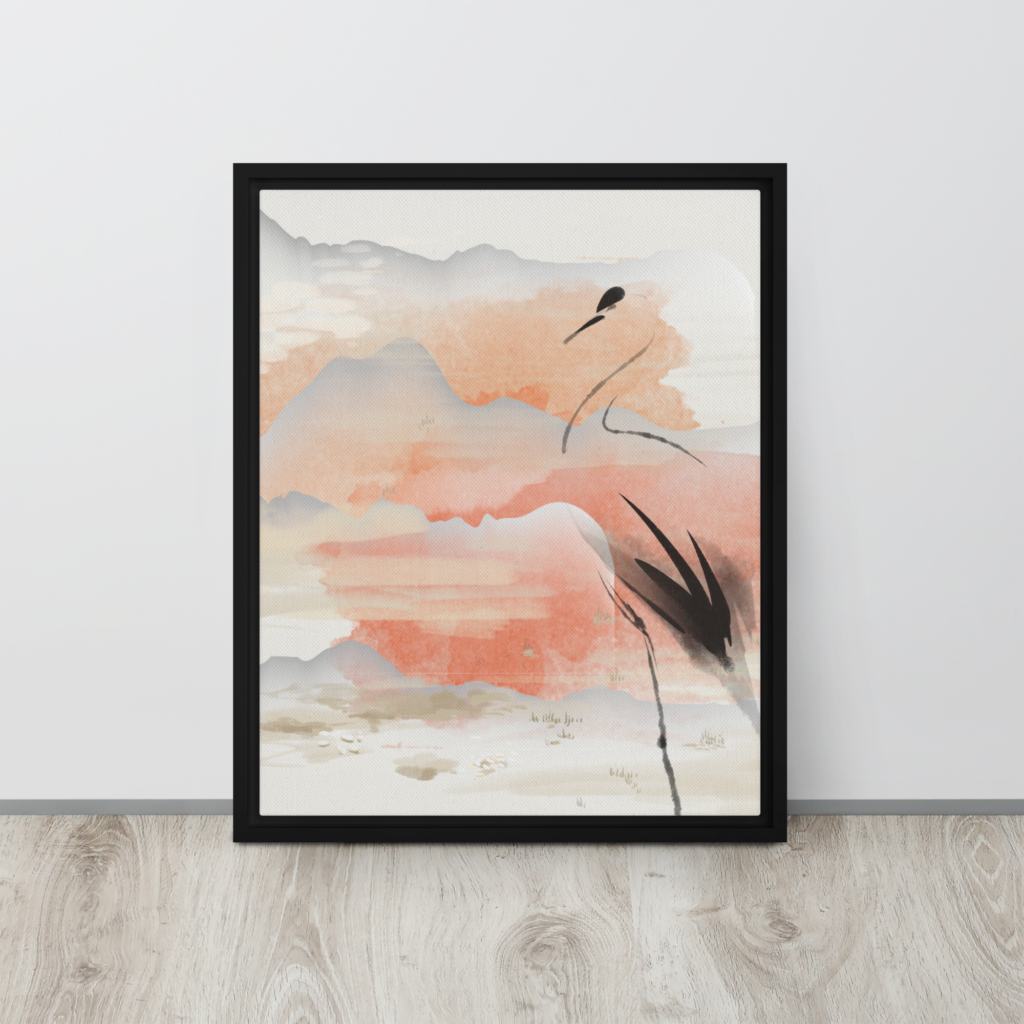
About AiMEiRi’s Canvas Prints
AiMEiRi was built around a simple idea: that the spaces we live in shape how we feel, and that art — chosen with intention — can be a quiet but powerful influence on our daily lives.
Every design in my collection is rooted in East Asian philosophy and aesthetics — drawing on principles like wabi-sabi, the Japanese appreciation of imperfection and impermanence; the Taoist concept of harmony between opposites; and the contemplative visual traditions of ink wash painting and minimalist composition. The result is a collection of digital designs that feel timeless, calm, and considered.
I produce all AiMEiRi prints on a durable polyester-cotton blend canvas with fade-resistant inks, and solid wooden stretcher bars and frames built to hold their shape. Every print comes framed and ready to hang, with the option of a standard frame or a floating frame to suit your style and space. The poly-cotton blend canvas is chosen specifically for its balance of print quality, moisture resistance, dimensional stability, and durability — qualities that make it well suited for art intended to be a lasting part of your home.
If you ever have questions about care, sizing, or finding the right print for your home, I’d love to hear from you.
Closing Thoughts
Caring for a canvas print doesn’t require special equipment or expertise. It requires a little consistency — a regular dusting, a stable environment, and the knowledge of what to avoid. The tips in this guide give you everything you need to keep your prints looking exactly as they did the day they arrived.
At AiMEiRi, I believe the objects we bring into our homes deserve to be treated with care — not because they’re fragile, but because they’re meaningful. A print that is well cared for becomes part of the fabric of a home. It ages gracefully, holds its color, and continues to do what it was designed to do: bring a sense of calm, beauty, and intention into your everyday life.
If you’re ready to find a piece that feels right for your space, browse the AiMEiRi collection. And if you found this guide useful, explore my other posts on home decor, art care, and the philosophy behind the designs.
Have questions about your AiMEiRi print? Get in touch — I’d love to help.